
The Rich Also Cry
The decision-making loneliness no one warns you about (and the 3 filters of the only person who can break it)

You made money. You built a company. You have people whose lives depend on the choices you make.
And you wake up at 3 AM with a thought you can't tell anyone.
At some point, you realize you don't have anyone left to actually talk to. You only have people who love you. If you're lucky, that is.
That's usually the first signal you've slipped into decision-making loneliness, the real version of being an entrepreneur that nobody ever warned you about.
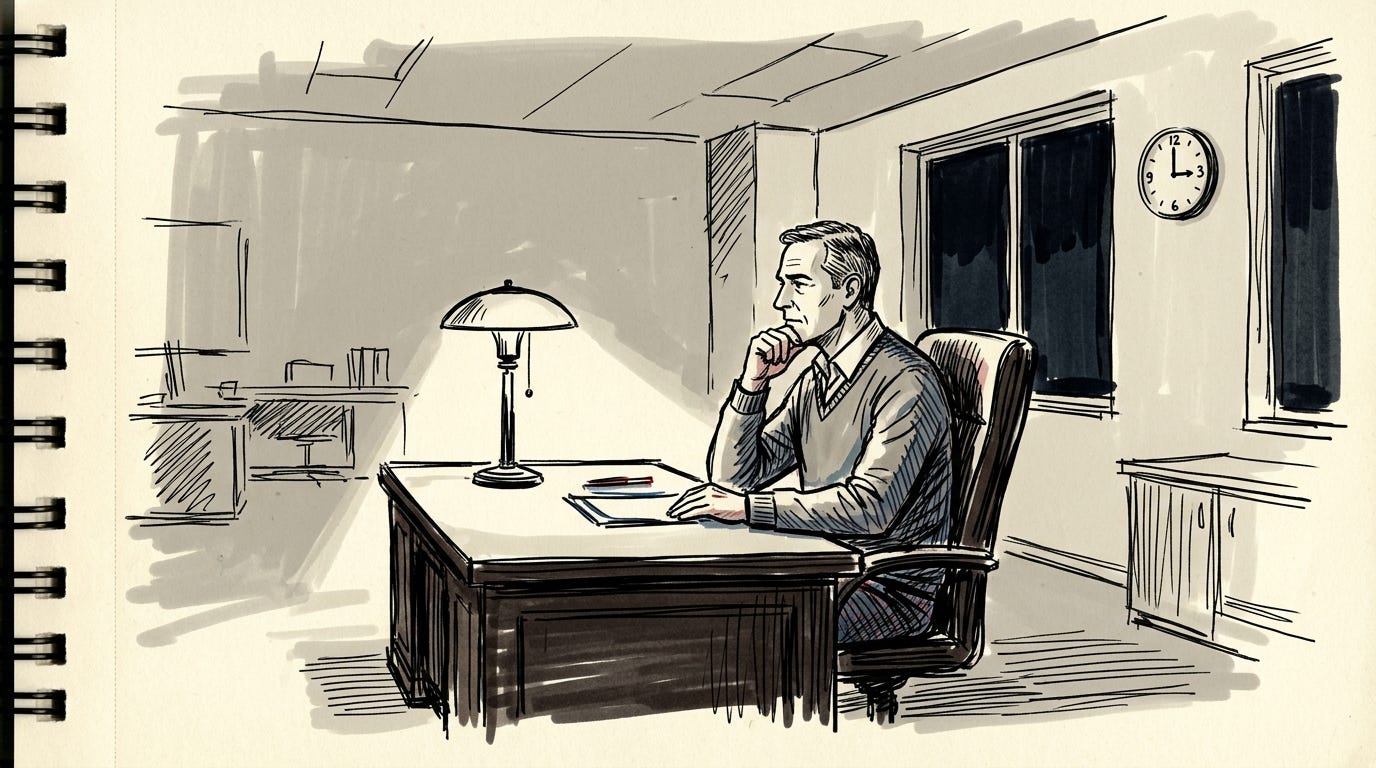
It's not physical loneliness. It's not a lack of friends, spouse, kids. It's something subtler and more dangerous: the absence of a real sounding board for the decisions that keep you up at night.
It happens when you stop counting numbers in thousands and start counting in "hundreds of thousands", in millions. It happens when fifty people depend on your choices. It happens when your life starts to look "aspirational" to other people.
"The Rich Also Cry" is actually a real thing. It's the English title of a Mexican telenovela called "Los Ricos También Lloran" that my Italian grandparents watched in the late 70s, dubbed. I never saw a single episode. But the title got stuck in my head, decades ago, and now it's finally useful.
Because if you're inside that aspirational life, once you get used to a different kind of comfort, the problems are still problems.
Except now you wake up and realize you have nobody you can put it all on the table with, in any honest way. Because, after all, "you're lucky." What are you even complaining about?
This isn't because you're surrounded by the wrong people. It's that you're surrounded by people, period.
To understand how you got here, just run through the five categories of people in your life and ask, for each one, whether you could actually be transparent with them.
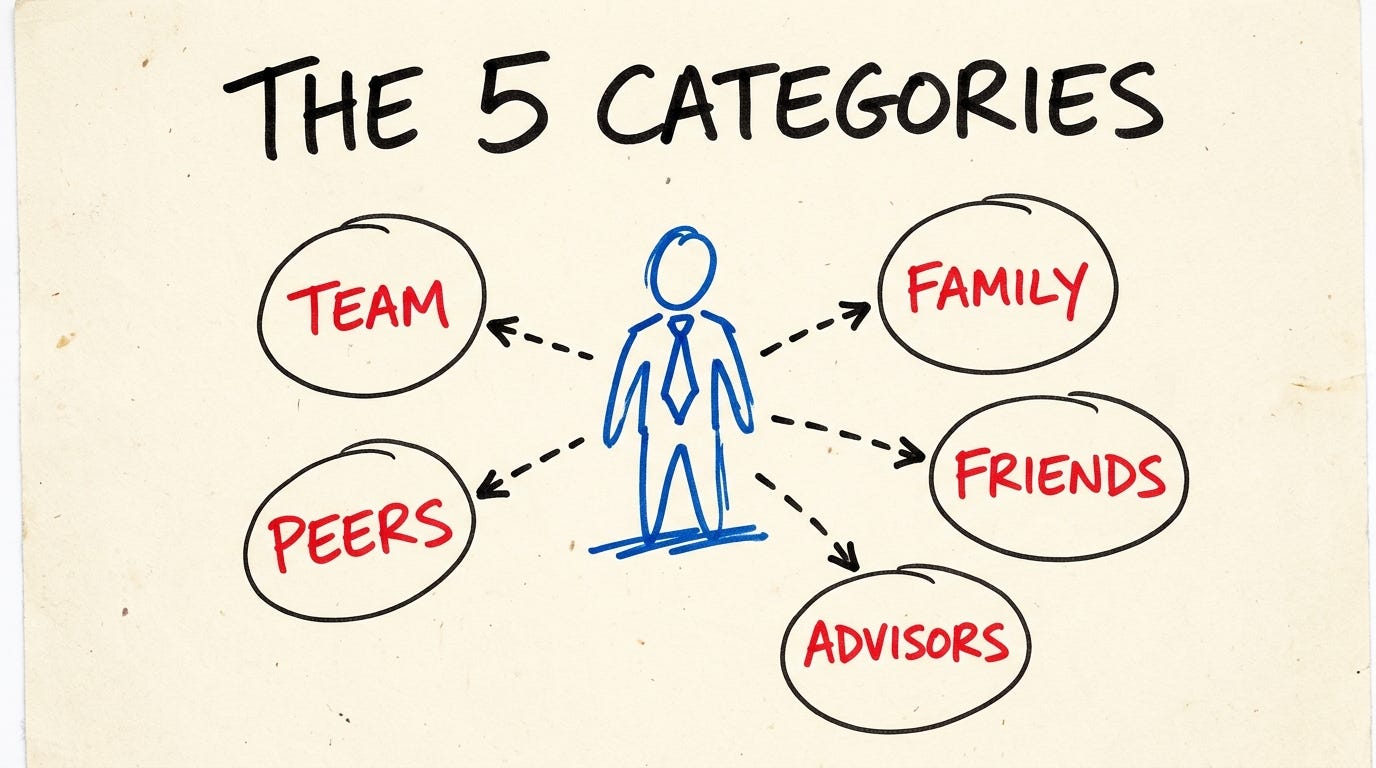
Your team. The people who work with you, even the very best ones, even your direct reports, have an implicit interest in never seeing you actually struggling. If you wobble, they wobble. If you show real doubt about a big strategic call, they lose trust, and that cascades into the company.
So when you have a real doubt, the kind like "should I sell off this division or keep it?", you can't put it on the table the way you would with a peer. You put it on the table pre-chewed, with the options already pre-filtered, because otherwise you scare them. They don't realize it, but they relate to you in "the boss needs to know" mode, not in "we're in this together" mode.
And honestly, that's fair. The maturity it takes to think "the boss probably has no fucking clue what to do right now, but I trust him anyway" is not something most people have. Even smart, good people. It's a level of comfort with uncertainty that gets built over years, and the average person never had to build it because nobody ever asked them to.
The person you live with, spouse, partner, whoever.
I know how this section can sound. It can sound like I'm dumping blame on someone who doesn't deserve it. I'm not. Even if they're the person you trust most in the world, even if they're sharp and capable, they're playing a different game than you. When you tell them the big things, they don't listen to it the way a peer would. They filter it through what it means for your life together, and that's completely normal.
For example, with my wife, I share everything. But it took me eighteen years to learn how to do that, and even today, there's still a bunch of stuff I implicitly filter. If I have a problem like "this quarter we might actually go under", I don't say it to her the same way I would say it to my trusted advisor. Because I have to protect her emotional reaction too. When you love someone, the natural instinct is to protect them. And protecting means filtering.
When you tell her you're thinking about a two-million euro investment in a new headquarters, she hears "two million" and reads it through what could change for the two of you. When you tell her someone offered you five million for a slice of your company, she hears "five million" and runs the same calculation: what does this mean for us.
She's not mean, she's not dumb. Her frame of reference starts, rightly, from your shared life, not from your company's strategy. And asking her to listen to you the way another founder would, on this kind of thing, is something you can't do without hurting her.
Old friends. The ones you grew up with, the ones you play pickup basketball with on Sundays, the ones at the bar. They're the emotional anchor of your normal life, and they shouldn't be made into anything else.
When you try to talk about a real strategic decision with them, one of two things happens. Either they admire you and say "dude, come on, you're a genius, you got this", and that doesn't help. Or they envy you a little and say "yeah, I'd love to have your problems", and that doesn't help either. Neither version is a useful conversation.
Consultants, accountants, lawyers. These people are paid to give you a technical opinion. They can tell you if a choice is tax-efficient, legally protected, financially sustainable. They can't tell you whether it's the right choice for you, for your life, for the direction you want your company to go. That's a different layer than theirs, and it's unfair to ask them to step into it.
And then there are fellow entrepreneurs. The ones you met at events, masterminds, clubs, the ones who run companies similar to yours or bigger. The ones who, on paper, should be the right place: they get it, they speak the language, they have the same problems.
In theory, yes. In practice, no, and here's a thing I figured out late.
There's a book that explains this better than anyone else: "The Status Game" by Will Storr. The thesis, boiled down, is that human beings constantly play status games with their peers, whether they realize it or not. This isn't about being a climber. It's a biological, automatic thing that switches on whenever you're standing next to someone in your category.
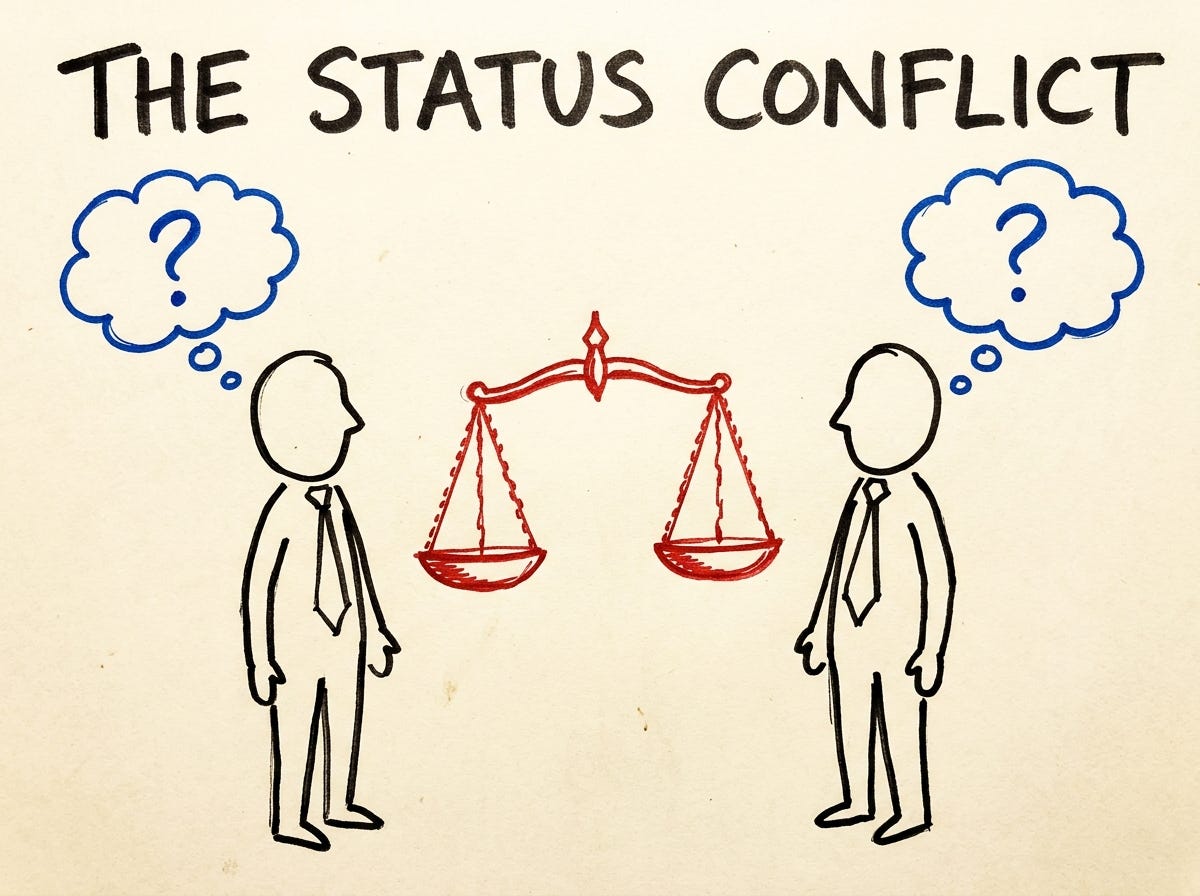
And that's where the trap is. In front of another entrepreneur at your level, a small part of you can't stop measuring. You don't want to show weakness, you don't want to show confusion, you don't want to look like someone "who isn't making it." Even if he'd actually understand, even if he's maybe in the same exact spot, the conversation never gets fully real. It's always filtered, even by ten percent, by that mechanism in the background.
That's why, paradoxically, the other founders in your industry are the worst people of all to talk to. The ones most like you are the ones with whom the status game fires hardest.
Five categories of people who love you or work for you. None of them is the right place to sit down with the actual decision.
You're left alone with your head, at 3 AM.
You also understand why nobody warned you about this.
The story they told you about being an entrepreneur is about challenge, freedom, building, satisfaction. All real things. What they never told you is that, past a certain level, every important decision becomes a conversation you have only with yourself.
They don't tell you because the people who have this don't volunteer it. Admitting it sounds like admitting weakness. "You're at a million in profit and you feel lonely? Get the hell out of here." Almost nobody will tell you "yeah, me too."
Like I said. The rich also cry. They just don't let you see it.
But under the skin, in pretty much every seasoned entrepreneur I've worked with, the same thing is there. It's almost a structural feature of the role, not a pathological exception.
And because nobody confesses it, every one of them convinces themselves they're the only one feeling it. They tell themselves "maybe I'm the problem." Maybe not. Maybe the problem is the role itself, when you actually do it well.
The ones I've seen handle this season well all have one thing in common, almost always the same: they've built themselves ONE peer. Just one, usually.
And here's where I want to name it properly, because it's more subtle than it sounds. The right peer has to pass three filters at the same time, not just one of three.
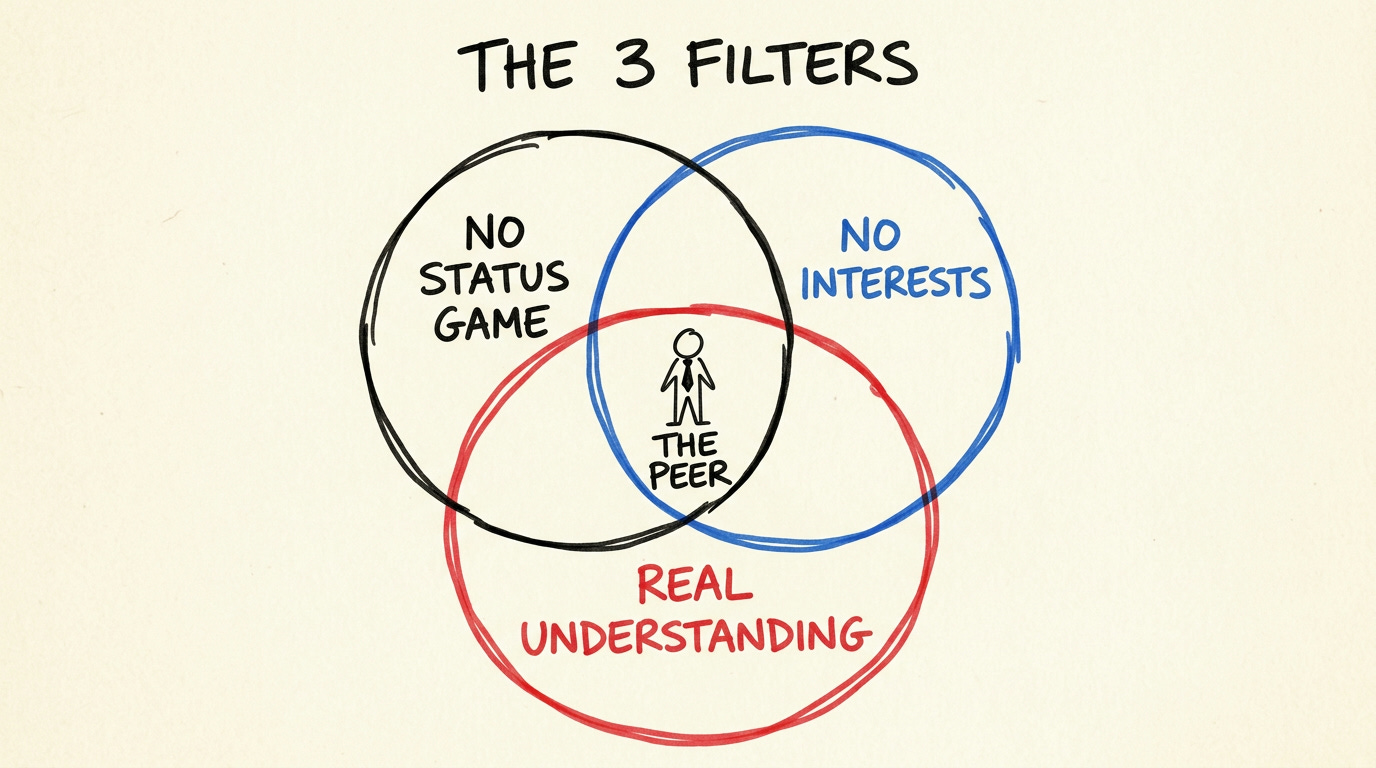
The first filter is what I call status conflict. It's different from regular conflict of interest, and it's the thing that throws most entrepreneurs off course when they're looking for a confidant. Conflict of interest you already know: the person giving you advice has a direct stake in pulling you one way or the other. You manage it, you watch for it, you usually spot it on sight.
Status conflict is something more slippery. It kicks in when the person you're talking to, even without any financial interest at all, is somehow measuring themselves against you. Maybe under the skin, maybe without even knowing it. From that moment on, anything they say to you is filtered through that mechanism, and you'll never quite know how much of their answer is "what's best for you" and how much is "what positions me better in this conversation." The status game doesn't shut off because you decide it should. It shuts off only when comparison is structurally impossible.
The second filter is the classic conflict of interest. What they tell you has to be one hundred percent in your interest, objectively, because they don't stand to gain anything in any direction.
The third filter, and this is the one most people underrate, is deep understanding of your challenges. This filter rules out a huge slice of the people who love you by default. Your parents, for example, might love you at the maximum possible level, and still have no fucking clue what you're actually wrestling with. Love without technical understanding isn't enough. Technical understanding without love isn't either.
The three filters together are rare, which is why THE peer is always just one. You almost never find that person by accident, and it's one of the most important searches you'll run in the next ten years of your entrepreneurial life. When you find them, you hold on.
Operationally, it's usually another entrepreneur at a similar level, with a company of comparable complexity, but in a field different enough that comparison becomes structurally impossible. Actually different, not "different but similar." If the two of you are in a room with other people and nobody ever asks "which of you has the bigger company?", you're on the right track.
With that person, you can be honest, you can lay the whole problem out, you can get a second perspective that isn't political. The value of that relationship, I mean, is incalculable. It's worth more than any consulting fee. You usually meet once a month, a morning, nothing formal.
Beyond finding the peer, they add structured individual thinking time. Half a day a week, or two hours a day, dedicated not to doing things but to thinking about things. No phone, no meetings, no planning.
Some write, some walk, some do both. What happens is that you give your head the time to surface what's already underneath. The problem with decision loneliness isn't that you're alone, it's that you never have time to FEEL what you already know. When you find that time, you realize the answer was usually already in there.
And then, slowly, they stop treating decision loneliness as a bug to fix. They start treating it as a feature of the role, like physical fatigue for an athlete. They're not trying to make it disappear, they're learning to manage it.
These things take a small amount of deliberate work. None of them shows up on its own. You build them on purpose.
If you want a quick gut check on where you are right now, think about the three most important decisions you've made in the last six months. The ones that cost you sleep, even just one night.
For each one, ask yourself: did I actually talk about it with someone, honestly, fully, without masking it? Or did I handle it alone in my head, maybe after pretending with my team or my spouse that I'd "shared" it?
If you didn't really talk seriously about any of the three, you have a decision loneliness problem. If you talked about one, you're average. If you talked about all three with someone who really heard you, you're an exception, and what you've built is worth gold.
For the other two scenarios, the only honest thing to do is look it square in the face. Stop pretending that "deep down I know what to do, I'll figure it out alone."
You usually do figure it out, sure. You just pay a massive price, and nobody tells you about it because you don't tell anyone about it yourself.
That price shows up over the years: decisions made a little too from the gut, opportunities missed because you didn't have time to think deep enough, a kind of exhaustion you've learned to call "work" but that has a different name.
I'm writing this because I keep thinking about all the entrepreneurs who, over my entire advisory career, have called me on a Saturday night to say "you got 5 minutes? I need to talk about something and you're the only one I can talk to about it." It was almost always people who, from the outside, looked like they'd made it. They had made it. And that's exactly why they were calling.
I don't know exactly what to tell you. Probably, if you recognize yourself in any of this, the first thing is admitting it to yourself, without telling anyone else yet. From there, you'll find your way.
It would be too easy, at this point, to close this piece with a pitch to work together. It's literally what I do for a living.
But the message of this article matters too much to turn it into a sales pitch. So I'm not making one.
I'll leave you with two things instead. The first is that if you recognize yourself here, you're normal. It's almost always the sign you've built something real, not a personal pathology. The second is that from here on out, you have to build yourself a protocol, whatever it ends up being. The deliberately distant peer, the weekly thinking time, the acceptance that this is a feature of the role and not a bug to debug. What you do with these three pieces is your business, and that's how it should be.
PDM